Saturday, April 24, 2021

Building Bhakashal - New Classes - The Cavoral
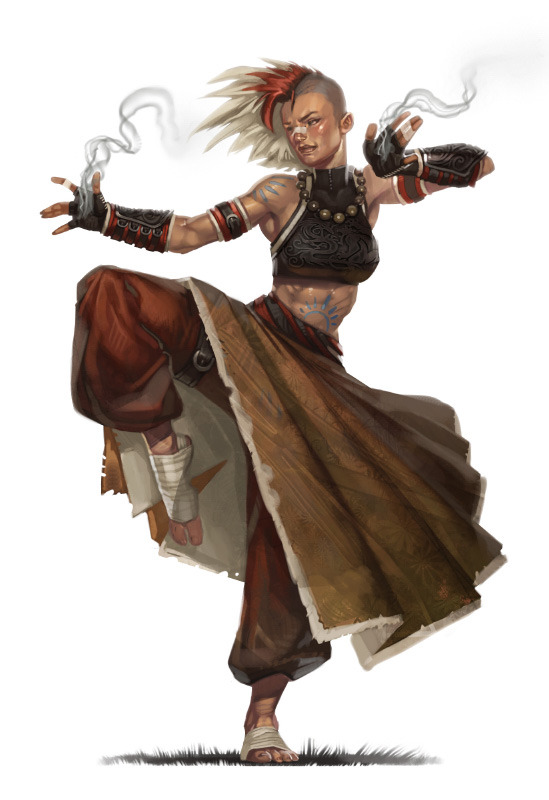
 The Cavoral

The Caveral is a subclass of warlock that specializes in evocation magic. In addition to this focus, the cavoral delivers their spells through dance. Each spell is represented by a series of motions carried out by the Caveral, all Cavoral spells have somatic components only. 


Hit Dice: d8

Experience Progression: As Spartan (Monk)

Armor: None

Weapon Proficiency Starting, Penalty and Progression*: As Spartan (Monk)

*note: there are no weapon restrictions on Cavorals, but they cannot carry weapons that will impede their movement, so they tend to have fewer weapons but gain greater expertise with them, e.g. use their weapon proficiency slots to improve existing weapons (+1/+1 per slot according to the Proficiency Bonus rules) rather than taking new ones at each opportunity.


Ability score minimums: 

Caverals require high stats in several areas, as their spell casting involves physical discipline. Their initial spread of stat is as follows:

DEX 12 STR 12 CON 14 INT 15


Those stats not given a value have a value of 9. 


Add 3 points anywhere desired, collectively or individually


Deduct 1 point from something


Abilties

1. AC, Move as Spartan (monk) of equivalent level 

2. Open Hand* attacks per round and damage, stun and kill odds as Spartan (monk) of equivalent level. 

2. Deflection of missiles and saving throw damage reduction as Spartan (monk) of equivalent level


*Note the open hand attacks of the cavoral resemble martial arts moves from Karate to Aikido to Judo to Capoeira, as well as Parkour, it is not uncommon for a Cavoral to flip off a wall to land a kick, or to do a handspring and land a blow in its culmination. 


Spell Casting

When a cavoral is training as an apprentice they take one item from their possession, it must be at least 4’ long, that item is the cavoral’s circle tracer.


Just like regular magic users have read magic, cavorals have the spell, “Trace the Circle”. Every Cavoral has this spell in memory, and when cast it makes their chosen item into a circle tracer. If it is destroyed, the cavoral must enchant a new one. If the Cavoral has cast all of their 1st level spells for that day, they must rest to cast it again and cannot cast spells until this is done.


The Cavoral trains for months to be able to draw a quick and relatively geometrically accurate circle around them. The circle is 5’ radius centered on the cavoral. All spell casting takes place inside this circle. Once the cavoral has laid down the circle with their item it functions as a protective circle: 2 point penalty to any attack against them, +2 bonus on any saves, and it hedges summoned and conjured creatures. 


It takes two segments to trace the circle, so add 2 to the casting time for the spell for the first round of combat, then after casting times are as listed. All spells take the same amount of time to cast as listed, generally 1 segment per level. 


The closest parallel to the spell-casting dance of the cavoral is a combination of capoeira and breakdancing, it is ground hugging, with explosive vertical leaps, bends, stretches, rolls, rises, drops, spins, flips dives and slides using the whole body, as well as movements of the arms, hands, feet, legs and head, all of which combine to cast their spells. 


Starting and final position and pose matter as much as the movements. A given sequence of these moves accompanies every spell, and must be carried out exactly from within the circle. 


If the circle is broken, the enchantment lasts for a number of additional rounds equal to the level of the caster before having to be retraced. This does not require the spell Trace the Circle, just the Cavoral’s Circle tracer. If the cavoral has no access to an object to use as a circle tracer, they can do so with their feet, they must cast circle tracer on themselves then walk an exact circular path. They must cast Trace the Circle on themselves once per day to do this. 


If a cavoral takes damage while casting a spell their dance is broken and the spell casting stops. However, the spell is not discharged or lost from memory. 


When the spell culminates the movement of the dance should manifest the result. To give a few examples:


Magic Missile - the cavoral does a spin of some sort, on hand, back, body, that culminates in one of their hands being thrust forward, and the energy, in the form of a sizzling purple sphere the size of a baseball, flies forth from there. 


Wall of Fire - The casting time for this spell is 4 segments, so that’s 24 seconds, in that time the cavoral will do a bend, a slide, and a stretch, then culminate by placing the hands behind their back touching, then bringing them around to the front where they touch again. As they separate from behind the cavoral a wall of fire appears in the air behind them, as they bring the hands forward the wall of fire forms and surrounds the cavoral, and when the hands meet in the front, the wall of fire closes the circle in front of them.


Shield - The cavoral springs upwards once landing with one foot pointing forward, again with one foot pointing right, then backward, then to the left. On the last landing the Cavoral spreads her hands out describing a “W” and the shield is manifested by a shimmer and flux in the air.


These are just for flavor, but should be suggestive.


Cavorals have the spell acquisition rules and the spells per day progression of a warlock. 


Spells Cavoral

Level / Spell Title

1 Hagellan's Thunderous Staff

1 Kansharr’s Darting Wasps

1 Magic Missile 

1 Morlan’s Dagger of Darkness 

1 Rillistan’s Shadow Weapon 

1 Rinnimar’s Chilling Touch 

1 Shield

1 Tenser's Floating Disc

1 Trace the Circle

2 Control Gasses

2 Fire Trap

2 Lyre Penwith’s Hidden Pockets 

2 Stinking Cloud

2 Web

3 Fireball

3 Glyph of Warding

3 Lightning Bolt

3 Miasma

3 Soromon’s Steps 

3 The Black Mist of Jax 

3 Thunder

4 Airot Civ’s Minor Shadow Walk

4 Candlin’s Minor Destruction 

4 Dig

4 Fire Shield

4 Fire Trap

4 Ice Storm

4 Illeana’s Raise the Chorus

4 Moorlith’s Rapidly Oscillating Strike

4 Raggelash’s Blackened Rain

4 The Penetrating Visor of Illyin Moonsabre

4 Tonnerath’s Torn Shadows

4 Wall of Fire

4 Wall of Ice

4 Wind Hammer

5 Bigby's Interposing Hand

5 Candlin’s Major Destruction

5 Cloudkill

5 Cone of Cold

5 Flame Strike

5 Ghanna’s Shadow Shield 

5 Higgenbotham’s Cantilever 

5 Wall of Fire

5 Wall of Force 

5 Wall of Iron

5 Wall of Stone

6 Bigby's Forceful Hand

6 Create Tulpa

6 Guards and Wards

6 Otiluke's Freezing Sphere 

6 Spiritwrack

6 Tenser's Transformation

6 The Emerald Lanthorn of Abinrus

6 The Stealthy Shadow Archers of Shon-Sinn

7 Bigby's Grasping Hand

7 Chariot of Sustarre

7 Delayed Blast Fireball

7 Demon Chain

7 Fire Storm

7 Hammer of the Gods

7 Lansharr’s Celerius Spatial Fugue 

7 Mereon’s Ebony Ribbons 

7 Mordenkainen's Sword

8 Bigby's Clenched Fist

8 Incendiary Cloud

8 Bigby's Crushing Hand

9 Meteor Swarm


Notes on New Spells

Cavorals get access to a number of new illusionist spells. Illusionists (phantasmists in Bhakashal) have access to spells that manipulate negative plane energy and shadow energy. So many of these spells (usually having “black” or “ebony” in the name) make up a number of the new spells available to them.


Note that if a Cavoral spell enchants a weapon the cavoral does not need to stay in the circle to use it. 


Thursday, April 22, 2021

 What To Do When Your Players Get Stuck in D&D - The Role of the Ref 


Inspired by a few threads on Twitter about “fail forward” mechanics, 

I thought it would be fun to go over some of the options other than FF mechanics. Not that you shouldn’t use

them, by all means go for it! But if you want other options, here are a few ideas.


What I gather from many of the discussions I’ve seen is that the purpose of fail forward mechanics is to keep the game from getting stuck. Sometimes your players hit a situation they can’t solve because of a failed roll, and the value of fail forward mechanics is that a failed roll still pushes you forward. 


That’s elegant design, and I appreciate it for what it is. 


But I played for years without it, and found there are a lot of other options for the ref to keep things moving that don’t involve coming up with fail-forward conditions for the roll. Also, sometimes the players are stuck and trying to figure out what to do and they don’t even have a roll to make, a fail forward mechanic won’t help with that! 


Here are a few things that have worked for me.


  1. Ask what they would do

Not as characters, but as people. I know this sounds odd, but I find asking them, “OK, but what would YOU DO if you had to cross a chasm” is sometimes useful. It gets them out of the perspective of their character’s skills and limitations and gets them to look at the problem on its own for a moment. When the players were stuck at a chasm in a recent session (the party had arrived at a chasm in a cave complex and none of them had fly or teleport or anything) I asked them this question. Eventually one replied, “well if the bandits came this way (they were trying to find the hideout of a large group of bandits and the trail had led here) they probably didn’t have the magic to get them all across, maybe there is another way across”. That led to some searching the area, and they found a cache of ropes and grappling hooks behind some rocks. 


  1. Ask why they are here

Sometimes reminding the group of their goals can allow them to realize that maybe they don’t need to do something. Right now my Friday group is going through Barrier Peaks, exploring a crashed spaceship. There are a LOT of rooms in that ship, and most are empty of anything useful. So they don’t have to search EVERY room, and the cards to get into some of those rooms are located elsewhere, so they might find them later. They were stuck on a door they couldn’t open, and were determined to get in. I asked them, “why are you here right now” when they were getting frustrated. Their task was to find out why monsters had been appearing in the valley near the crashed ship. This was just one door of hundreds in the ship. Suddenly the penny dropped, they didn’t have to go into this particular room right now. So they left. 


  1. Review the environment

Players are always at an information deficit compared to their PCs, they don't have anywhere near as much information as their PCs would. So reviewing the environmental features can sometimes get the players to an epiphany. In my Tuesday group one of the party members has eyes of the eagle, and while on a road travelling spotted a group of flying creatures coming from a distance. So they had warning, but they couldn’t decide what to do. They were freaking out, as the flying creatures were perytons, and a decent sized group as well. They got stuck. 


So I said, “Where are you right now”


“Travelling to Gorsham”


“No, where specifically are you at the moment”


“On the road”


“What’s around the road”


“Ummm, I don’t know”


“When you started out this morning I showed you the map, what was on the map” 


Silence...  wait for it… 


“THE ROAD FOLLOWS THE EDGE OF THE FOREST, WE COULD HIDE IN THE TREES”


Bingo.


  1. Review their character sheets

As an OSR guy I’m big on the idea that the answer isn’t always on your character sheet. BUT SOMETIMES IT IS. Players forget what’s on their sheet, forget what their spells can do, forget their abilities and items, ALL THE TIME. Sometimes we pull out the sheets and go over them together and see if there is anything useful. And that can lead to fun stuff. My Thursday group once wanted to make a big signal fire but were worried about causing a forest fire as they were in a dense section of the forest. We reviewed sheets and discovered that the warlock had affect normal fires, and affect normal fires grows the fire but doesn’t add to the heat. 


  1. Draw parallels with past situations they may have forgotten

The players sometimes forget when they did things in the past that were similar to what they are facing now. You can’t assume they will remember everything from past sessions, or what worked before. I think it’s fair to remind them of past actions when this happens. In a recent game the PCs needed to draw their opponents away from a spot and get to that spot while they were away. They were stuck on how to do that. So after some time I reminded them of the last time they used levitate on an opponent. The spell lasts for 40 minutes at their level, and when it ends the object comes plummeting down to earth at a terrific speed. They put two and two together and found a large rock (400 lbs is the limit), gave it a push when it started levitating up so it was over a pile of rocks, and let it rise for the full 40 minutes. Meanwhile they got close to the spot they were looking to get into. Then the spell expired, and the 400 pound rock came crashing down from 400’ in the air, that made some noise. The noise drew out their opponents and gave them an opening. 


  1. See if anyone has a relevant skill or background that would give them a clue

Even in OSR games PCs have skills outside of their class, and sometimes these are relevant to the task at hand. I had a group stuck on crossing a fast moving river, they were worried about monsters in the river so they didn’t want to swim. They also didn’t want to try and find another way around. So I told them to check their skills. One of them had “carpenter” as a skill, and they asked if they could build some sort of raft. Of course, you don’t have to be a carpenter to build a raft, but once they were reminded of the skill, it occurred to them to do so.


  1. Take 5

For real. Tell them to take a break. Players can get like a dog with a bone sometimes, but the stress of it makes it hard to think. Get up, walk away from the table, take a smoke break, grab a snack, take a bathroom break. Whatever. Just walk away from the task and refocus. The heat of the moment can make it more difficult than it needs to be.


  1. Have something happen that pushes them forward

This is the closest I come to “fail forward”, the environment they are in is not static, there are other things around. If they are standing around a door trying to decide if they should go through it maybe something COMES THROUGH THE DOOR. Also, I don’t stop rolling for random encounters or wandering monsters when the PCs are stuck on a task. THINGS HAPPEN WHILE YOU TRY AND FIGURE IT OUT. 


  1. Don’t create environments where the PCs get bottlenecked

If you create a bottleneck in the game you have to be prepared for the fact they might not get past it. That means that there should be multiple ways to achieve your goals. They don’t have to be obvious or easy, but in most cases there should be more than one option to solve the problem.


  1. Give them permission to leave or do something else

This is a big one. I have a group going through White Plume Mountain right now and they made it past the gynosphinx and the pit, the hall of copper plates and the frictionless room. They arrived at the inverted Ziggurat with the scorpions, manticores, etc. and just hit a wall. They spent a while discussing strategy and just couldn’t decide what to do. One of them turned to the others and said, “OK, lets go explore the rest of the dungeon, maybe we will find something to help us there.”


Winner, winner chicken dinner.


I think they got to the point of being able to do this as I’ve pointed it out to them a ton of times, just because they are trying to do something they don’t HAVE TO KEEP DOING IT if it isn’t working at the moment. It’s a big game world, get out and explore it!


  1. Give them hints

This is a last resort, but I have used it a few times. Given the information gap between PCs and players, I think it’s fair sometimes to just drop a hint. Don’t give away the game, don’t make it too obvious, but sometimes even a small clue will get them moving in the right direction. They still have to figure it out, they are still being challenged, but it will lower the frustration level to have some progress.


The point of all of these suggestions is that you aren’t telling them exactly what to do, or giving them the answer, you are giving them prompts so that THEY can figure out the answer, or at least a course of action that moves the game forward. Just moving them on to the next situation to avoid “failure” robs them of their agency to some degree, giving them prompts still requires them to make decisions, be observant and achieve goals, but it doesn’t bog down the game or make their decisions for them.  


I have started off 7 groups over the last two years, and every one of them has had an observable learning curve with respect to this issue. At first they want to do everything, beat every challenge, solve every problem. But over time they learn to pick their battles, and to be OK with walking away or trying unconventional things. I think many players fear that if they don’t complete task X then the ref won’t have anything for them to do. After playing with me for a while they see that THERE IS ALWAYS SOMETHING ELSE TO DO, so they don’t feel the need to solve every problem or solve it right away.


Monday, April 19, 2021

Building Bhakashal - Playable Groups 


I played bog standard AD&D for many years, loving every minute of it, but for the most part I played humans. The main reason for that is that I adored Lord of the Rings, read it when I was 12, but I had no desire to play my favorite characters or their poor cousin analouges. LOTR is like mythology or religious text to me, it isn't for gaming. So I saw a lot of elves, dwarves and halflings, but generally didn't play them.


Then in college I played in a game where the ref allowed lizard men to be PCs. He had seen the Rogues gallery and seen that boss Jeff Dee lizard man character (pictured above).


It ends up that the people who MADE the game played centaurs and lizard men and stuff.


What the hell!


I was hooked.


I want Bhakashal to have a sword and sorcery/Vancian vibe, so much like Talislanta I dumped the Tolkien elves, dwarves, etc. and tried something different. 


First off, the use of “race” to describe what would otherwise be called species created a lot of confusion, so Bhakashal does not have “races”, it has “playable groups” (PGs).


The mythology of Bhakashal has gods with animal / human forms, and many chimerical beasts. Bhakashal exists billions of years in the future, and it is assumed that at some point, humanity created both artificial intelligence and became able to evolve animals into sentient, bipedal, tool using form. The AI evolved and transcended this reality, they are now the gods of the setting. Some of the sentient groups of evolved animals survived and grew in number, and over the billions of years intervening developed sustainable populations. 


Now no one knows which group came first, that knowledge is lost to the mists of time.


Bhakashal is populated by 10 playable groups:


Playable Groups - Bhakashal

Chitin - Insect People (C) 

Garudin - Bird People (G) 

Humans - Primate People (H)  

Jugyi - Turtle People (J)  

Kutya - Dog People (G)  

Malu - Fish People (M)  

Rakasta - Cat People (R)  

Saan - Lizard People (S)  

Togmu - Frog People (T)  

Vodnik - Castor People (V)  


Bolded groups are the most common, and the Saan are the most numerous of those.


Each PG in Bhakashal is differentiated in certain ways. If there is to be any point to playing something other than a human, there should be some ways of showing that difference in the game. However, rather than create detailed, elaborate cultures for each, Bhakashal uses 11 points of differentiation for each to achieve the role-playing goal of making the PGs different enough to be interesting, but similar enough to be playable. Some contiguity with familiar motivations is necessary to make adventuring possible.   


Note on Alignment: There is no alignment for PGs. Each PG will have institutions and structures in their societies that create factions, and factions in Bhakashal have alignments, but no PG has a dominant or common alignment.


Playable Group Features

1. Physical Description - Each PG has variation in physical description within that group. So for example, the garudin are “bird people”, but some are bipedal hawks, falcons, swallows, chickens, ducks, etc. Chitin are “insect people” but some are ant-like, some grasshopper-like, some bee-like, etc. This applies for every PG, including humanity. 


Players may choose their variation.


2. Ability Bonuses - Though there are no ability score penalties, there are ability score bonuses associated with each PG. They reflect obvious features such as size and structure, and the way folklore/mythology/literature have treated the various animals they are evolved from. 


3. Class  - There are no class restrictions, any PG can be any class. However, each PG will have one or more classes associated with it, e.g. these classes are popular within that group, but PCs may be of any class and PG combination. 


4. Skills - Each PG will have common skills historically associated with that group, players can take those or roll for skills at skill assignment.


5.  Abilities - Each PG will have abilities related to its morphology, e.g. turtle people will be able to breathe underwater and swim well, bird people can fly, etc. But there can be exceptions, for example, just like there are flightless birds there can be flightless garudin. But the default abilities will be listed. 


6. Appearance - Each PG will have a style of dress and appearance that is popular with that group, again, players may choose to ignore this and dress and appear in any way they like, but it is a starting point for the ref.


7. Technology - Each PG will have two or more technologies, one usually a weapon, historically associated with that group. Players can take that technology or take others when generating equipment. When using a preferred technology they will gain a +1 (or +5%) on any rolls associated with it. 


8. Custom - Each PG will have a custom associated with them. Of course, every group will have many customs, this is only a single example to use as a role playing prompt and to inspire other customs for that group to be created in the game.


9. Art - Each PG will have a form of art that is highly valued in their group. Of course, different forms of art are valued in all of the PGs, but this particular form is held to be important by the majority of this particular PG. The ref and the players can riff off of this to determine what other forms of art are important to that group if they like.


10. Gods - No one god is worshipped exclusively in any PG, however, each PG has a god or group of gods that are most commonly worshipped. 


11. Virtue - Each group has a virtue that is held in high esteem within that group. The idea is that the sentient groups will have members that exemplify all of the various virtues (and vices) to some degree, but with respect to one particular virtue, each of the PGs tends to hew to it closely. There are of course exceptions, but they are just that, exceptions.


Here is an example of one of the PGs in Bhakashal, the Garudin (bird people).


Garudin 

Physical Description - Garudin have arms separate from their wings, and wingspans of 8 to 16 feet depending on variations. They all have beaks/bills, some have head crests or body crests, and all have large eyes. All are feathered, not bat-like or dragon-like.


Ability Bonuses - +1 to DEX and +1 to INT


Class - Popular classes amongst Garudin are Mercenary, Jinx and Spider.


Skills - Popular skills/trades amongst Garudin are Musician, Trader, and Bowyer/Fletcher


Abilities - Garudin can walk at 9” and fly at 36”, have 3 natural attacks per round (CCB) 1-2/1-2/1-3, SA: dive attack = 2 point AC penalty and +4 to hit, x2 to damage, excellent vision, when in air are surprised on a 1 in 6 and surprise others on a 3 in 6, and get +10% on all thief skills. They will wear no heavier armor than leather or a metal breastplate with vambrace/greaves.


Appearance  - Garudin wear loose, baggy clothing on their bodies, and prefer lightweight, thin fabrics. They do not have tattoos but they do wear jewelry, though mainly on the hands and arms. They prefer colors that compliment their plumage for the most part, tending to exemplify what is there rather than contrasting with it. 


Technology - Garudin make high quality harps and stringed instruments, and most garudin will have a +1 to hit with the crossbow.


Custom - Garudin will extend their wings when wanting to appear important or to signal approval. 


Art - Garudin love music, many are musicians instrument makers (particularly stringed instruments), but all are interested in and knowledgeable about music. Those with an intelligence of 15 or higher act as sages with a minor field in musicology.


Gods Mohlk (god of birds, communication), Uvir (god of the air, wind) and Qonru (god of the sun) are popular amongst Garudin. 


Virtue - Garudin Society values clever wit and wordplay, elaborate jokes, mocking the powerful and humor that highlights hypocrisy are all popular. 


How it Works

To be clear, in each case the player can choose to adopt these features if they want, these are meant as baselines to flavor the game world, not essential features. The cultural features represent snapshots of how these groups behave when the players enter the game world. Over time, in the campaign, the ref and the group can change any of them, as they would change over time on their own as groups change. 


So if the referee and players are so inclined they could have Garudin fashion change and different kinds of clothing become popular, none of this is set in stone. If a Garudin PC wanted to wear heavier, gaudier clothing that’s fine. These are meant as generalities of the same form as, “Many Canadians wear jeans”. 


These are meant primarily as role playing prompts for the players so they can flavor their PC, they can choose to ignore them, or riff off them with the group and the ref to build that aspect of their character and in doing so create the lore of these PGs for their version of Bhakashal. 


Saturday, April 17, 2021

 Agency in D&D - The Roll of the Dice

I decided to answer a question on Twitter about bad rolls in D&D and how they impact the game here as the answer is a bit long. First, a digression.


The first few times I played Catan I despised the game. I rolled badly at the start and I ended up with terrible tiles. Then the rest of the game was watching everyone else build while I sat around doing nothing, as I couldn’t get resources. So I didn’t like the game. We bought several expansions, Seafarers, Cities and Knights, Traders and Barbarians, etc. and each of them had the same problem, too few resources for some players when playing by the rules. Then one night I sat down and combined every set together into one huge game board.


They we played, we decided on a 20 point game because of the expansion, and it was great. There was enough game board available that everyone got to have resources and build, even if some did better than others. There was still agency in the game, I find that’s the big issue.


In D&D, the problem for me is this. I want dice rolls in the game, randomization makes the game world seem immersively real, and it takes some of the burden of decision making off the referee. There is something valuable to achieving a goal, overcoming an obstacle, when you know that you did it independently of help from the ref and despite game mechanics that are independent of everyone. There is a sense of achievement, and it is, in part, meaningful and rewarding because it contrasts with the times that you lose, and the dice don’t work out


So for me, I want to keep dice rolling in the game, I don’t want players to be able to say, “that didn’t happen”, independently of the dice. When you roll them, they should count, otherwise I think their value and impact on the game is lessened. 


However, I also feel the problem of bad rolls, not that any one particular failure is a problem, because there have to be some failures, otherwise the game loses it’s interest. But long strings of failures, particularly when you don’t get to play often, are an issue. 


I addressed this issue in my games when I had “that player”, the one who almost always rolled badly. The inner statistician in me knows that for the most part dice work as advertised, if you roll a d20 then 1’s will come up about 5% of the time, give or take. But nonetheless I have known players who have this issue, for whatever reason. 


Here is what I do in the game to mitigate the issue. 


First, old school D&D recommends that players describe what they do and the referee only rolls if they feel that the outcome is uncertain. This approach is underused as many players expect, and even insist, on having a game mechanic for everything they want to do, or to have their actions end up at a game mechanic. 


But part of the point of a referee is to give the game another option resolution without mechanics or rolls. In this situation, it isn’t the roll that matters, it’s the player's ability to make a convincing case for something. This can take the form of the ref telling them their idea worked, or it can be a modifier for the roll. So for example, one of the PCs in my Friday group is a shipwright. They were looking to book passage on a ship leaving the city. Problem was that they were short on funds. So the PC walked the docks and asked how each of the ships looked. “Which one needs work?” He was a shipwright, so I figured he could tell by doing an inspection, and I told him that the Lion’s Roar was the most run down looking ship. So he spent time checking it out, and asking where the problems were. I told him some details, and when they asked about passage and it came to price, the PC mentioned that he was a shipwright, and that he could fix X, Y, Z etc. on the voyage in exchange for a discount. Now, according to the rules I can roll for this to see how the purser reacted, use a charisma modifier, etc. 


Instead, I decided that the purser would just say yes. It was a good deal for them, and it was good play on the part of the player to ask these questions and leverage their skill. Not everything requires a roll. Once players realize this, they start looking for ways to interact with the environment that don’t rely on the dice. 


So this is one solution for the problem, it won't’ help with combat rolls or saves, but it can help with other rolls, and give that player who can’t roll other forms of agency in the game to achieve things. 


For the combat rolls and saves part, I have two suggestions. 


First, whatever you decide to do, I would NOT recommend that you leave it to the ref to make the decision on when to overrule the dice. I know this seems counterintuitive, but hear me out.


If the ref can change rolls, then, inevitably, players  will ask, “why didn’t she change the roll THAT time”? And that’s a good question. As the ref, I DON’T WANT to have to make that decision, ever. I want the dice to decide for me as often as possible, as this makes my role as objective as it CAN be. Favoritism, intentional or otherwise, can happen as well, which should be obvious. If you rely on the ref to resolve this issue through direct intervention, the burden is on them to be fair, and that’s a big burden to allocate. 


However, I also don’t recommend playing in a game where the players can just say, “That didn’t happen” whenever they want. There are a few reasons for this. First, it takes away some of the immersion and excitement from the game, as you know you can always “roll it back”.


It also means that the dice lose their impact, why bother rolling if the players can just say no? I’ve tried this sort of playstyle with D&D a few times, and it becomes weird really fast. Players can get decision paralysis when they realize they can just make things happen by fiat. 


To be clear, there are games that use cooperative decision making by players and these games are hunky dory. D&D is not one of those games, it was designed, and all iterations of it were designed, for some form of dice/ref resolution with input from players. It wasn’t designed for ‘that didn’t happen’ mechanics. 


So the solution is to integrate the “that didn’t happen” into existing mechanics, rather than putting it on the ref. I think it makes sense to give players a way to influence things, the key is that it can’t be ALL OF THE TIME, it has to be SOME OF THE TIME. Fortunately, as is often the case, the answer is right there in the game, you just have to change your lenses to see it.


In AD&D if you have a high dexterity, when you are surprised you neutralize one segment of surprise per point of DEX RAA. So the dice roll happens, but your DEX can neutralize the result. 


So sometimes it can roll it back. 


A monk in 1e who is hit by a successful “to hit” roll with a missile weapon can roll a saving throw to deflect the missile. That takes an existing die result (the “to hit” roll) and changes it. 


AD&D also has a lot of “passive narrative mechanics”, eg. saving throws and HP. The reason your 5th level fighter doesn’t die from the sword stroke that would kill a common soldier is that they are lucky, agile, etc., this manifests in the game in the form of HP. But HP are there if you choose to use them or not, that’s why they are “passive”, but they are definitely story or narrative mechanics, as they reflect the hero’s ability to survive and progress despite things that would take out a minor character in the story. Saving throws are the same thing they mean you always have a chance of surviving, even in situations that appear hopeless, because you are the hero of the story. Gygax frames saving throws in exactly this way, the hero always has a shot.


So the game already has the answer, just take what is already there and leverage it, so for Bhakashal, the AD&D setting/retroclone I am creating, you divide PC’s HP by 4, and that’s how many of their hit points they can actively add as modifiers to other rolls. In short, it takes a passive luck point mechanic that always works to absorb damage (hit points) and gives it to the PCs so they can spend those points on other things, adding to the “to hit” roll, or adding to the saving throw. Once they are all spent, you can’t spend more until you are back to full HP again.


So say I have 12 HP. I am allowed to spend 3 hp to change rolls. Say I take 2 hp damage from a sword. Then I decide to spend 3 hp to change a saving throw. Now I have 7 hp left and I can’t spend any more hit points until I’m back to 12 HP again. So you need to be thoughtful about when to use them.


The key to making this work and not becoming a case of always ignoring the dice is that HP are a limited resource, and the PCs only get to spend ¼ of their max total HP on this mechanic. So it has a real cost (if you want to spend 2 HP to make that saving throw when you only have say 4 hp left, it’s a tough call), and the resource is limited (if I have 5 of my HP to spend and I spend those 5 hp.


Stars Without Number has a class mechanic that allows you to reroll a failed skill check a limited number of times per day. In Bhakashal anyone can sneak (roll to see if you surprise the enemy) but if a thief fails to surprise the enemy, they get to roll a move silently to try again.


The hack I use for Bhakashal (¼ of your HP are available to change rolls) works easily with any standard D&D game, but you could simply give a player X number of rerolls per session or per game day, as long as it is limited then the player has agency in deciding how to use it. The agency makes it important. If you allow them to reroll any result, the dice lose their efficacy and impacts and the game becomes very different. If you give them limited access but provide some mechanic, it preserves the value of the dice, gives them some agency back as they have to be involved in making the decisions that save them. 


I saw this happen in my last game, one of the PCs refused to spend any of his HP allocation on rolls for the adventure, so when he came to a decisive point, he had them available to him. 

When the adventure was over, I looked at him and said, “That was a good decision, not spending any of your discretionary HP early on, it made the difference in the fight”. He was beaming, as he knew it was because of good play on his part. 


One last thing. The tweet that was part of this original discussion (not from Ajit George, but from Banana Chan) had a line in it that I wanted to address.


“... giving players narrative control in TTRPGs when they fail a roll overlaps with having safe, responsible play”.


I think this is a dangerous equivalency to make. Because in the heated, divisive TTRPG sphere, this quite easily translates into: “Those games which don’t give narrative control to players when they fail a roll are unsafe or irresponsible”. This is of course a possibility, but that remains to be explored, and it seems unnecessarily inflammatory to frame it this way given the way the discourse is around TTRPGS.


It can also elide very quickly into, “referees who do not give players narrative control in TTRPGs when they fail a roll are unsafe and irresponsible referees.” To be clear I am NOT suggesting that this was the implication, but it would be disingenuous to suggest that it will not be made.


I’ve seen it made before, people have suggested here in game design Twitter that the role of the DM is essentially one with a God Complex, that DMs have psychological issues because they play a game where they have such power, that the DM’s roll is inherently adversarial and hostile, and they almost always end up in some sort of psychological evaluation of the role of the ref. 


I don’t think that’s a fruitful avenue to pursue. Instead, I think the focus needs to be on solutions that mitigate the extreme cases (players that consistently roll badly) while preserving the value of those rolls to the game.


  Building Bhakashal – Session Report We’re Back! We broke for the year back in June and started back up this weekend, my Thursday group...